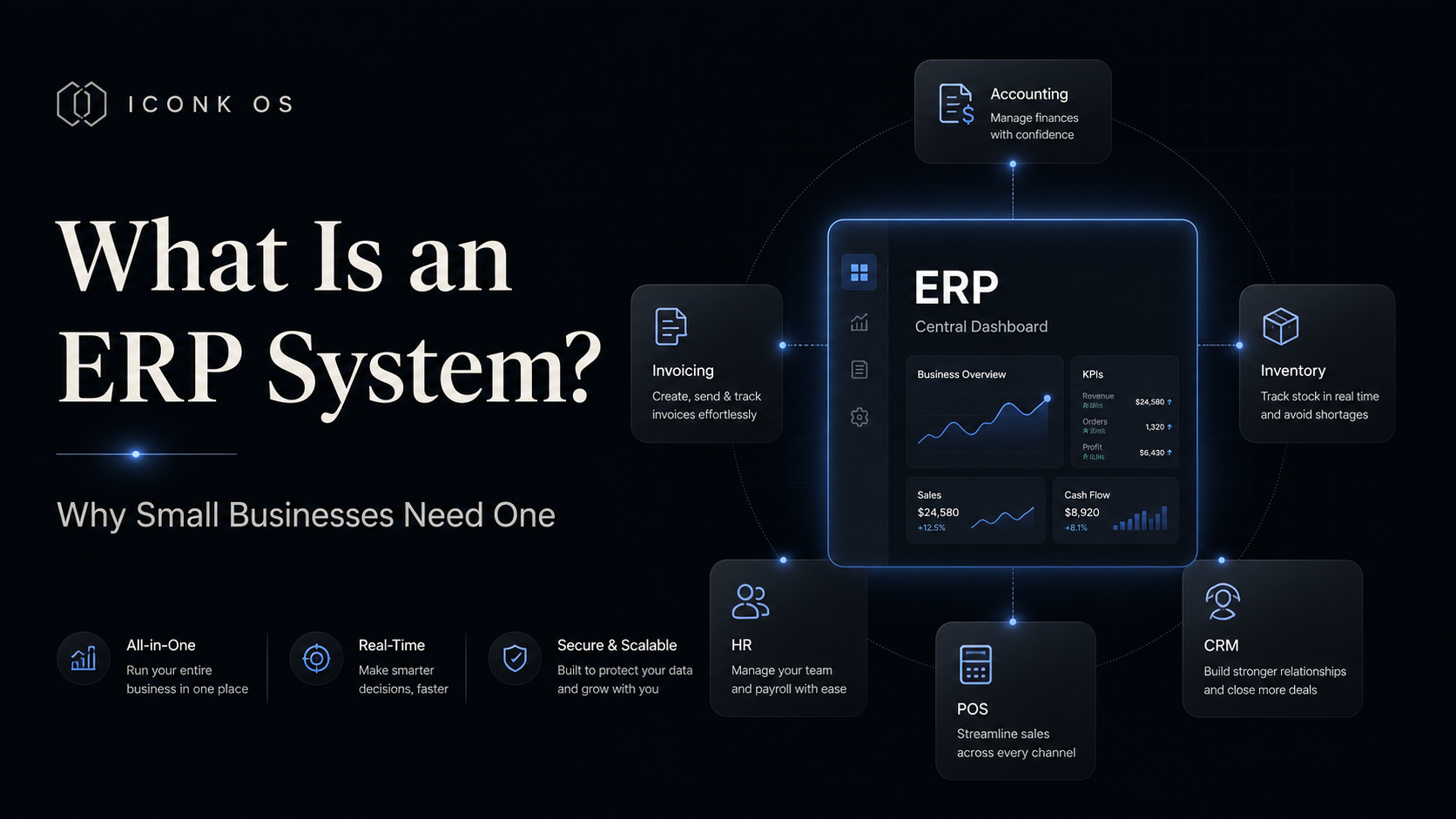
What Is an ERP System and Why Small Businesses Need One
Many small businesses start with simple tools like spreadsheets, notebooks, WhatsApp messages, and separate apps for invoicing, inventory, payroll, and customer communication. In the beginning, that may feel enough. But as the business grows, these disconnected tools often create confusion, delays, and costly mistakes.
That is where an ERP system becomes important.
ERP stands for Enterprise Resource Planning. It is a system that helps businesses manage their daily operations from one connected platform. Instead of using many tools that do not work together, an ERP brings everything into one place.
What Is an ERP System?
An ERP system is business software designed to connect the main parts of a company, such as:
- Accounting and finance
- Invoicing and billing
- Inventory management
- Purchasing and suppliers
- Sales and customer records
- HR and payroll
- Reports and business insights
Instead of each department working separately, everyone works on the same system with the same data. This gives the business more control, better visibility, and fewer manual tasks.
How Does an ERP System Work?
An ERP system works by connecting different business functions through shared data.
For example, when a sales invoice is created, the system can automatically update:
- Financial records
- Customer balances
- Stock levels
- Business reports
This reduces repetition and helps avoid errors.
Think of it as one central workspace for your business. Rather than searching across different apps and files, your team can manage operations from one platform.
Why Small Businesses Need an ERP System
Some people think ERP systems are only for large companies, but that is no longer true. Modern ERP platforms are also very useful for small businesses, especially those that want to grow in a more organized way.
1) Better organization
Small businesses often struggle when information is scattered across many tools. An ERP keeps important data in one place, making operations easier to manage.
2) Fewer manual errors
When your team enters the same data in multiple places, mistakes happen. ERP software reduces duplicate work and improves accuracy.
3) Real-time visibility
With an ERP system, business owners can quickly see sales, expenses, stock levels, invoices, and team activity. This makes decision-making faster and more informed.
4) Stronger inventory control
If your business sells products, inventory mistakes can become expensive. An ERP helps track stock movements, product availability, and purchasing needs more clearly.
5) Faster invoicing and payments
Manual invoicing wastes time and may lead to delays. ERP software helps businesses create, send, and track invoices more efficiently.
6) Easier growth
As a business grows, operations become more complex. An ERP system creates a structure that supports expansion, new branches, larger teams, and more customers.
Common Signs Your Small Business Needs an ERP
If your business is experiencing any of the following, it may be time to move to an ERP system:
- You use too many separate apps or spreadsheets
- Your invoices, stock, and reports do not match
- Your team wastes time on repeated manual tasks
- You do not have clear visibility into business performance
- Inventory issues happen too often
- Financial tracking feels messy or delayed
- Your business is growing but operations feel harder to manage
What Should Small Businesses Look for in an ERP?
Not every ERP system is the same. Small businesses should look for a solution that is practical, easy to use, and flexible enough to grow with them.
Important features to look for include:
- Easy onboarding and clean interface
- Accounting and invoicing tools
- Inventory and product management
- Sales and customer management
- HR or employee tools
- Reports and dashboards
- Role-based access and permissions
- Cloud access for teams and branches
- Flexible pricing that fits smaller businesses
How ICONK OS Helps Small Businesses
ICONK OS is built to help businesses manage operations from one connected platform. Instead of juggling many disconnected tools, businesses can use one system for:
- Accounting
- Invoicing
- Inventory
- HR
- POS
- CRM
- Reporting
- Daily business operations
For small businesses, this means:
- Better visibility across daily operations
- More organized workflows
- Less manual work
- Improved reporting and decision-making
- A platform that can grow with the business
Whether you are managing a small team, one branch, or planning to scale, having the right ERP system can make your business more efficient and easier to control.
Final Thoughts
An ERP system is no longer something only large companies need. For small businesses, it can be one of the smartest ways to improve operations, reduce errors, and prepare for growth.
If your business is starting to feel more complicated than it should, an ERP system may be the next step.
Looking for a modern business operating system?
Explore ICONK OS to see how accounting, invoicing, inventory, HR, POS, and CRM can work together in one platform.
Quick Summary
If you want the short version, here it is:
- An ERP system connects core business operations in one platform
- Small businesses use ERP systems to stay organized and reduce manual work
- ERP software improves visibility, reporting, and team efficiency
- It helps businesses manage accounting, stock, invoicing, and operations more effectively
- A good ERP system also supports long-term business growth
Frequently Asked Questions
What does ERP stand for?
ERP stands for Enterprise Resource Planning.
Is ERP only for large companies?
No. Modern ERP systems are also useful for small businesses and growing teams.
What can an ERP system manage?
An ERP system can manage accounting, invoicing, inventory, sales, HR, payroll, customer records, and reporting.
Why do small businesses need ERP software?
Small businesses need ERP software to reduce manual work, improve visibility, avoid mistakes, and grow in a more organized way.
Can ERP help with inventory and invoicing?
Yes. ERP systems are very useful for tracking stock, managing invoices, and improving day-to-day operations.